
ENVIRONMENTAL & WASTE MANAGEMENT ANALYTICS IN THE AREA
Building Pollutants
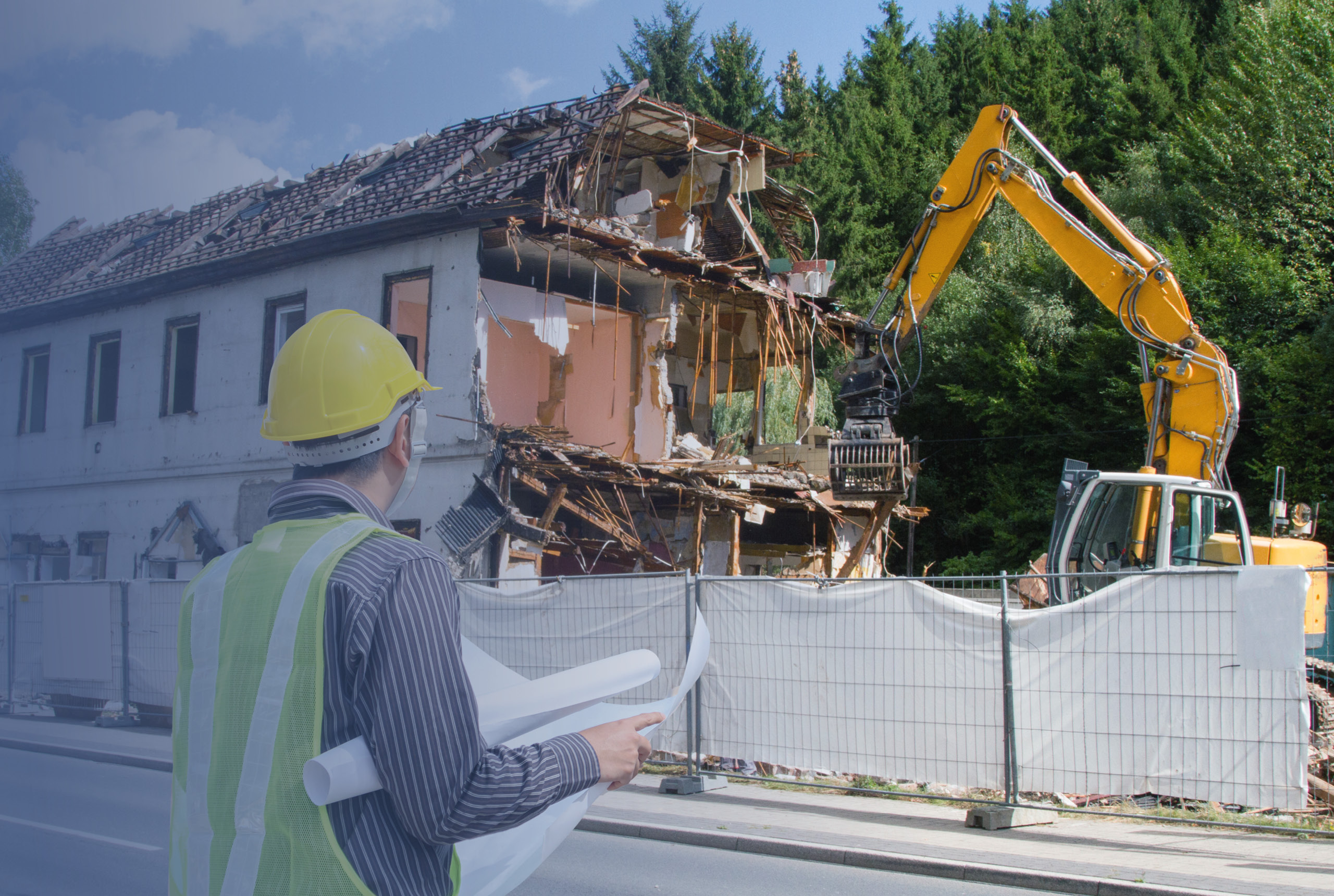
Many private or industrial buildings constructed between 1950 and 1993 have the potential to contain pollutants that may pose a risk to people and the environment. Due to their mostly positive material properties, they were components of building products, but turned out to be harmful to health and carcinogenic several decades later. Many toxic substances, such as asbestos, are now banned, but they are brought to light during renovation, repair or remodeling work.

The amendment to the Hazardous Substances Ordinance (which came into force in December 2024) brings with it some significant changes for construction practice, particularly when dealing with asbestos and other carcinogenic hazardous substances. Among other things, this means an extended duty to cooperate and provide information on the part of the building owner and client. They must now pass on all relevant information about possible pollutant contamination in buildings to the companies carrying out the work. This applies in particular to buildings constructed before 31 October 1993, as asbestos is likely to be present in the building fabric.
Another change is the introduction of the so-called ‘traffic light model’ for the risk assessment of activities involving carcinogenic hazardous substances. The model divides activities into three risk areas: low, medium and high risk. Depending on the exposure, appropriate protective measures must be taken.
These changes mean that construction companies and trade businesses must adapt their work processes in order to comply with the new regulations. It is particularly important to train employees in dealing with the new regulations and protective measures.
Therefore, building products suspected of containing asbestos or other harmful substances should be analysed before any renovation work is carried out. This not only creates legal certainty, but is also essential to protect the health risks for employees and residents and to minimise long-term risks.
For this reason, every well-planned demolition project includes a professional and expert preliminary investigation in accordance with TRGS 524 to identify pollutants and contaminated sites, the creation of a pollutant register and the subsequent remediation of buildings and land with the necessary protective measures in place to avoid delays in construction and health hazards.
Have you bought a house that was built between 1950 and 31 October 1993?
It is advisable to carry out a pollutant analysis before renovating or remodeling older properties in particular. This way you can ensure that no harmful materials have been used and start the planned measures with peace of mind.
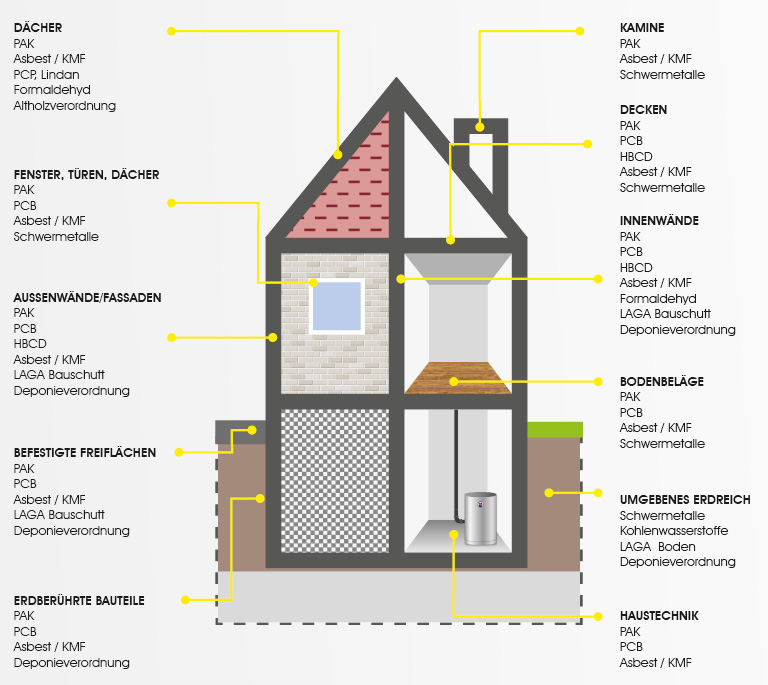
If the property has not yet been renovated, it is possible that it contains harmful building materials. In the adjacent graphic you will find examples of frequently occurring pollutants and their typical locations in buildings.
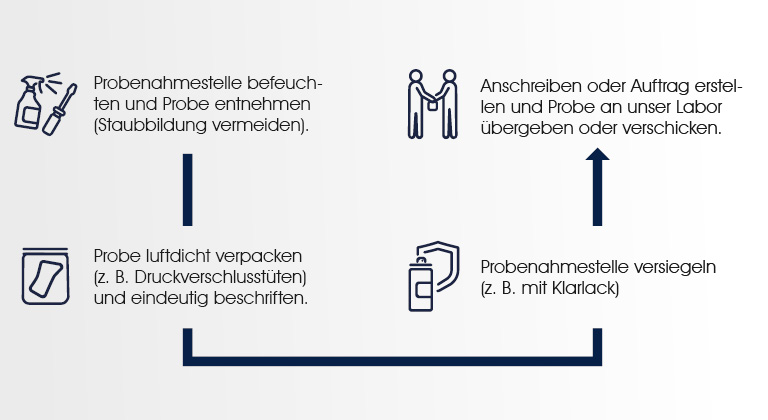
If you have a concrete suspicion, you are welcome to take the sample yourself and bring it to our laboratory in airtight and dustproof packaging or send it by post.
If you want to have a larger building sampled for pollutants, or if you need help assessing the materials in your building, we will take over the assessment for you and take the samples during an inspection of the property.
Please bear in mind that there are other building products containing harmful substances in addition to the typical suspected asbestos products such as Eternit slate and insulation containing asbestos in night storage heaters, for example.
We analyse the sampled building materials in our laboratory for pollutants such as asbestos, MMF, PAH, PCB, wood preservatives and heavy metals. We can rely on modern equipment and expert personnel to provide you with accurate results. Typical analysis methods used are:
Gas chromatography (GC-MS)
Scanning electron microscopy (SEM)
Optical emission spectroscopy (ICP-OES)
Mass spectrometry (ICP-MS)
For enquiries about these analyses, please contact our laboratory team at anfrage@industrial-lab.de or get in touch with your contact person:
Head of department
Organics / REM
02762 9740 - 28
Send e-mail

Asbestos / Scanning electron microscopy
02762 9740 - 57
Send e-mail


